Shortcut to subtract any 5 or 6 digit number in seconds

Shortcut to subtract any 5 or 6 digit number in seconds
Shortcut to subtract any 5 or 6 digit number is a trick you can use to subtract 2 numbers in seconds.
Subtraction is the opposite of addition. Suppose we have to subtract two numbers such as 15-2=13.Then,In this subtraction the first number 15 is called the minuend meaning to be made less and the number 2 is the subtrahend meaning that which is to be subtracted and the number 13 is the difference.
Minuend-subtrahend=difference
When Minuend is larger than the subtrahend, there is no problem in subtracting.
Example:Minuend is 162 and the subtrahend is 51 and we are required to subtract the numbers.
1  6  2
–   5  1
———
1 4  1
———
We can easily get the difference whether we do it from right or left.

But what if we had to subtract 45 from 64
if we start using the method of borrowing that we are so used to from our school days no doubt we will arrive at the difference but it is not that easy.

There is a simple trick that you can use here to get the
difference easily and within seconds.


Shortcut to subtract any 5 or 6 digit steps

Lets discuss the steps now
Step 1: Subtract the numbers of the subtrahend from the Minuend 

Step 2: If any digit in subtrahend is more than Minuend then add a circle on difference you get on subtracting.
Step 3:Now wherever circle is there it means the complement of the number(10- number)
Step 4:If there is any digit before the circled number then 1 must be subtracted from the number.

We shall now consider some examples to understand better


Examples on shortcut to subtract 5 or 6 digit number 


Example 1: 47-28=?
Observe that the Minuend is 47 and Subtrahend is 28 where the unit’s place digit is more than the minuend’s units digit.
First we subtract as usual  
  4  7
– 2  8
  ———
   2 1  
  ———-      

Note that 8 is more than 7 so we add a circle on 1
We find Complement of the difference(1)=10-1=9
Subtract 1 from previous number(2) as the next digit is circled
We get 
  4 7       

 -2 8
 ———
 2  1

 1  9    


Ans  47-28=19


Example 2: 37-29=?
Minuend is 37 and Subtrahend is 29
First we subtract as usual  
        3 3
       -2 9
    ———
        1 6    

Note that the unit’s place digit(9) of subtrahend is more than the unit’s place digit(3) of minuend so we add a circle on the difference 

We find Complement of the difference(6)=10-6=4
Subtract 1 from previous number(1) as the next digit is circled
We get, 

 3 3

-2 9

 ———
 1 6
 0 4    


Ans 37-29=4


Example 3: 65381-42497=?
First we subtract as usual  

 6 5 3 8 1
-4 2 4 9 7
 —————
 2 3 1 1 6

Add circle on the digits 6,1,1 as these digits of the subtrahend are more than their corresponding digits in minuend
We get,

  6  5  3   8    1

 -4  2  4   9    7
  ———————
   2  3  1  1  6
  ———————

Now we find complements of the circled numbers 
Complement of 6=10-6=4
Complement of 1=10-1=9

We get, 
  6  5  3  8   1
– 4  2  4  9   7
 ——————-
  2  3 9  9  4
 ——————-
Subtracting 1 from the numbers previous to the circled numbers
We get,
 6  5  3  8  1
-4  2  4  9  7
 ——————
 2  2  8  8  4
 ——————-

Ans   65381-42497=22884


Also see
What is complement of a number?

Data analysis and interpretation tricks-bar-chart diagrams

Data analysis and interpretation tricks

Data analysis and interpretation problems are given to test how keenly you can observe things and not to test your ability to calculate.Let us now see some data analysis and interpretation tricks to get the answer quickly without much calculations.


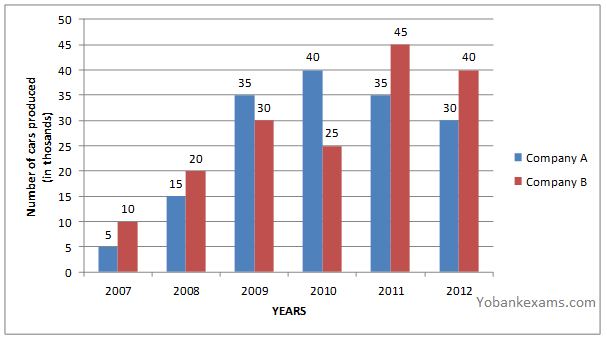
Study the following graph carefully and answer the questions   below.

Data analysis and interpretation bar chart diagram

(1)In which year the percentage increase or decrease in the production of company B to that of company A was maximum?

Basic concept
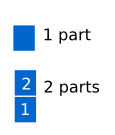
First of all we shall look at each bar as group of parts and understand the concept of parts.

for example In the above bar chart diagram, In 2007 company A has 1 part and company B has 2 parts
In 2008 company A has 3 parts and company B has 4 parts.

Steps to find percentage increase or decrease

We  shall follow the below steps to arrive at our answer
Step 1:Count the number of parts of company A and company B
Step 2:Compare the number of parts of company B with company A for all years.
Step 3:Check which year the difference in the number of parts is maximum.That is the year the percentage increase or decrease is maximum

In the above example we notice the following
2007
Number of parts of A=1
Number of parts of B=2
Increase=1

2008
Number of parts of A=3
Number of parts of B=4
Increase=1

2009
Number of parts of A=7
Number of parts of B=6
Decrease=1


2010
Number of parts of A=8
Number of parts of B=5
Decrease=3


2011
Number of parts of A=7
Number of parts of B=9
Increase=2


2012
Number of parts of A=6
Number of parts of B=8
Increase=2

We observe that in the year 2010 the number of parts of B is 3 less than the number of parts of company A so 2010 has maximum percentage decrease in comparison to the other years

Ans  In the year 2010 percentage decrease in production of company B is maximum compared to company A.


2 digit multiplication trick whose tens digit is same

2 digit multiplication trick whose tens digit is same
You must be wondering we have learnt so many multiplication tricks for 2 digit numbers,so how is this going to be helpful.Well, Knowing new tricks and where the trick can be applied to get the answer quickly can make all the difference. 2 digit multiplication trick whose tens digit is same is one of those tricks that you will learn today.

Condition to apply this trick is 
When the ten’s place digit is same and the unit’s place digits add up to 10 then you can apply a shortcut trick to easily multiply any 2 digit numbers.

2 digit multiplication trick whose tens digit is same

Now,let us see the steps in detail

Step 1:To get the unit’s place digit multiply the unit’s place digit of the both the numbers.

Step 2:To get the ten’s place digit multiply the ten’s place digit with its consecutive(next) number.

Step 3:Place the result obtained in step 2 to the left of the result obtained in step 1.

Let us now practice some examples

Example 1: 26 x 24=?
We observe that ten’s place digit of both numbers=2
and by adding unit’s place digit of both numbers(6+4=10)we get 10.

Hence, we can apply this trick

Step 1:Multiplying the unit’s place digits we get
Unit’s place digit=6 x 4=24

Step 2:Multiplying ten’s place digit by its consecutive number we get
Ten’s place digit=2 x 3=6

Step 3:Placing the result of step 2 to the left of the result obtained in step 1 we get
624

Ans  26 x 24=624


Example 2: 43 x 47=?
We observe that ten’s place digit of both numbers=4
and by adding unit’s place digit of both numbers(3+7=10)we get 10

Step 1:Multiplying the unit’s place digits we get
Unit’s place digit=3 x 7=21

Step 2: Multiplying ten’s place digit by its consecutive number we get
Ten’s place digit=4 x 5=20

Step 3:Placing the result of step 2 to the left of the result obtained in step 1 we get
2021

Ans  43 x 47=2021


Example 3: 38 x 32=?
We observe that ten’s place digit of both numbers=3
and by adding unit’s place digit of both numbers(8+2=10)we get 10

Step 1:Multiplying the unit’s place digits we get
Unit’s place digit=8 x 2=16

Step 2: Multiplying ten’s place digit by its consecutive number we get
Ten’s place digit=3 x 4=12

Step 3:Placing the result of step 2 to the left of the result obtained in step 1 we get
1216

Ans  38 x 32=1216


Example 4: 65 x 65=?
We observe that ten’s place digit of both numbers=6
and by adding unit’s place digit of both numbers(5+5=10)we get 10

Step 1:Multiplying the unit’s place digits we get
Unit’s place digit=5 x 5=25

Step 2: Multiplying ten’s place digit by its consecutive number we get
Ten’s place digit=6 x 7=42

Step 3:Placing the result of step 2 to the left of the result obtained in step 1 we get
4225

Ans  65 x 65=4225


Example 5: 71 x 79=?
We observe that ten’s place digit of both numbers=7
and by adding unit’s place digit of both numbers(1+9=10)we get 10

Step 1:Multiplying the unit’s place digits we get
Unit’s place digit=1 x 9=09

Step 2: Multiplying ten’s place digit by its consecutive number we get
Ten’s place digit=7 x 8=56

Step 3:Placing the result of step 2 to the left of the result obtained in step 1 we get
5609

Ans  71 x 79=5609

What is complement of a number

What is complement of a number

The distance of a number from a convenient round number(base) or how far the number is from its base is known as the complement of a number.
Numbers such as 10,100,1000 are usually taken as bases as they are friendly numbers.
It is a simple concept but very helpful when you apply this concept to solve problems.
Suppose you want to substract two difficult numbers then if you know the complement of the numbers then you will be surprised to see how quickly you can mentally calculate the answer.

Let us now find out the complements of numbers taking different bases.

First lets start finding complement of numbers from 1 to 9 with 10 as base
10-1=9
9 is a complement of 1

10-2=8
8 is a complement of 2

10-3=7
7 is a complement of 3

10-4=6
6 is a complement of 4

10-5=5
5 is a complement of 5

10-6=4
4 is a complement of 6

10-7=3
3 is a complement of 7

10-8=2
2 is a complement of 8.

10-9=1
1 is a complement of 9.

Now lets take the base as 100 and find complements of numbers

To find the complement of a number with 100 as base follow the below steps
For the unit’s place digit find the complement of the units place digit with 10 as base
For the ten’s place digit find the complement of the ten’s place digit with 9 as base

We shall now practice few examples to perfect the skill that we learnt
100-11=?
Steps
For the unit’s place digit find the complement of 1 with base 10 (10-1=9)
For the ten’s place digit find the complement of 1 with base 9 (9-1=8)

Ans 100-11=89

100-21=?
Unit’splace digit=Complement of 1 with base 10 is 9(10-1=9)
Ten’s place digit=Complement of 2 with base 9 is 7(9-2=7)

Ans 100-21=79

100-42=?
Unit’splace digit=Complement of 2 with base 10 is 8 (10-2=8)
Ten’s place digit=Complement of 4 with base 9 is 5 (9-4=5)

Ans 100-42=58

Now lets take the base as 1000 and find complements of numbers

To find the complement of a number with 1000 as base follow the below steps
For the unit’s place digit find the complement of the units place digit with 10 as base
For the ten’s place digit find the complement of the ten’s place digit with 9 as base
For the hundreth’s place digit find the complement of the hundreth’s place digit with 9 as base

We shall now practice some examples
1000-121=?
Unit’splace digit=Complement of 1 with base 10 is 9 (10-1=9)
Ten’s place digit=Complement of 2 with base 9 is 7 (9-2=7)
Hundreth’s place digit=Complement of 1 with base 9 is 8 (9-1=8)

Ans 1000-121=879

1000-472=?

Unit’splace digit=Complement of 2 with base 10 is 8 (10-2=8)
Ten’s place digit=Complement of 7 with base 9 is 2 (9-7=2)
Hundreth’s place digit=Complement of 4 with base 9 is 5 (9-4=5)

Ans 1000-472=528

Note
If the unit’s place is 0 then Ignore the 0 and start finding the complement of the number from the next digit.
For example lets say we want to find the complement of 220
1000-220=?
Unit’s place digit=0
Ten’s place digit =Complement of 2 with base 10 is 8 (10-2=8)
Hundreth’s place digit=Complement of 2 with base 9 is 7 (9-2=7)

Ans 1000-220=780

1000-470=?
Unit’s place digit=0
Ten’s place digit =Complement of 7 with base 10 is 3 (10-7=3)
Hundreth’s place digit=Complement of 4 with base 9 is 5 (9-4=5)

Ans 1000-470=530

More Math tricks>>