Vedicmath trick to multiply 3 digit by 3 digit

Vedicmath trick to multiply 3 digit by 3 digit

Vedicmath trick to multiply any two 3 digit numbers can be done mentally in seconds. Three digit multiplication is not a difficult task as much as we all dread.In fact, you will enjoy doing 3 digit multiplication once you know this amazing trick. Take your time to understand the technique and practice a lot until you master the technique.Because it so happens that we read a lot of tricks and techniques but can’t remember the exact technique during exam and feel so helpless.You don’t want to be that person!

Let us understand the technique using an example

Suppose we want to multiply 121 by 310.Step 1:First multiply the unit digits of both the numbers.
We get 0 x 1= 0 as shown below

Step 2:Now multiply unit digit of second number(310) with tenth digit of 1st number(121) and also multiply unit digit of first number(121) with tenth digit of 2nd number(310) and add the resulting products.
We get,(0 x 2) + (1 x 1)=1

Step 3: Now multiply unit place digit of the second number(310) with the hundredth place digit of 1st number(121)
And multiply unit place digit of first number(121) with hundredth place digit of second number(310)
Also multiply tenth place digit of second number(310) with tenth place digit of first number(121)
And find the sum of the resulting products.
We get (0 x 1) + (3 x 1) + (1 x 2) = 5
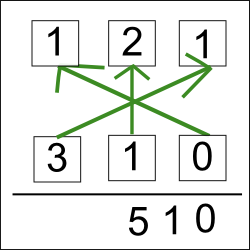


Step 4:Multiply the tenth place digit of second number(310) with the hundredth place digit of 1st number(121) and multiply the tenth place digit of 1st number(121) with hundredth place digit of 2nd number(310) and find the sum of the resulting products.
We get (1 x 1) + (3 x 1) = 7
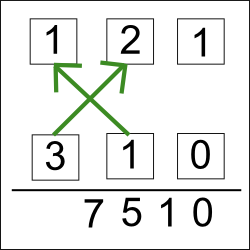
Step 5:Multiply the hundredth place of second number(310) with the hundredth place digit of first number(121).
We get (3 x 1) = 3
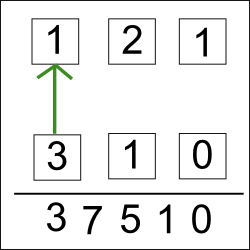
We have arrived at our final answer!

121 x 310 = 37510
Shortcut to square any number from 90 to 99

Shortcut to square any number from 90 to 99

Shortcut to square any number from 90 to 99 is one of my favorite that I like to apply when I see a number such as 98 or 99 as all I need to know is how to subtract and square of numbers from 1 to 9.

Now lets go through the steps

Step 1:Assume 100 as base and find the difference between the number to be squared and 100.

Step 2:Subtract the difference in step 1 from the number to be squared to find tenth place digit.

Step 3:Square the difference and place it next to step 2.

Once you know the technique you can square any number from 90 to 99 mentally.


Examples

Let us see few examples to understand better

Example 1: 98²=?
Step 1:Assuming 100 as base, we shall find the difference
100-98=2
We get the difference as 2

Step 2:Subtracting the difference(2) from the number to be squared(98) we get,
98-2=96
96 is the tenth place digit

Step 3:Squaring the difference we found in step 1 we get
2²=4
4 is the Unit place digit.
Ans 98²=9604


Example 2: 99²=?

Step 1:Assuming 100 as base, we shall find the difference between the number to be squared(99) and 100.
100-99=1
We get the difference as 1

Step 2:Subtracting the difference(2) from the number to be squared(98) we get,
99-1=98
98 is the tenth place digit

Step 3:Squaring the difference we found in step 1 we get
1²=1
1 is the Unit place digit.

Ans   99²=9801


Example 3: 97²=?

Step 1:Assuming 100 as base, we shall find the difference between the number to be squared(97) and 100.
100-97=3
We get the difference as 3

Step 2:Subtracting the difference(3) from the number to be squared(97) we get,
97-3=94
94 is the tenth place digit

Step 3:Squaring the difference we found in step 1 we get
3²=9
9 is the Unit place digit.

Ans   97²=9409


Example 4: 96²=?

Step 1:Assuming 100 as base, we shall find the difference between the number to be squared(96) and 100.
100-96=4
We get the difference as 4

Step 2:Subtracting the difference(4) from the number to be squared(96) we get,
96-4=92
92 is the tenth place digit

Step 3:Squaring the difference we found in step 1 we get
4²=16
16 is the Unit place digit.

Ans   96²=9216


Example 5: 94²=?

Step 1:Assuming 100 as base, we shall find the difference between the number to be squared(94) and 100.
100-94=6
We get the difference as 6

Step 2:Subtracting the difference(4) from the number to be squared(96) we get,
94-6=88
88 is the tenth place digit

Step 3:Squaring the difference we found in step 1 we get
6²=36
36 is the Unit place digit.

Ans   94²=8836

Quantitative aptitude trick for clerical and bank po examinations

Quantitative aptitude trick for clerical and bank po examinations
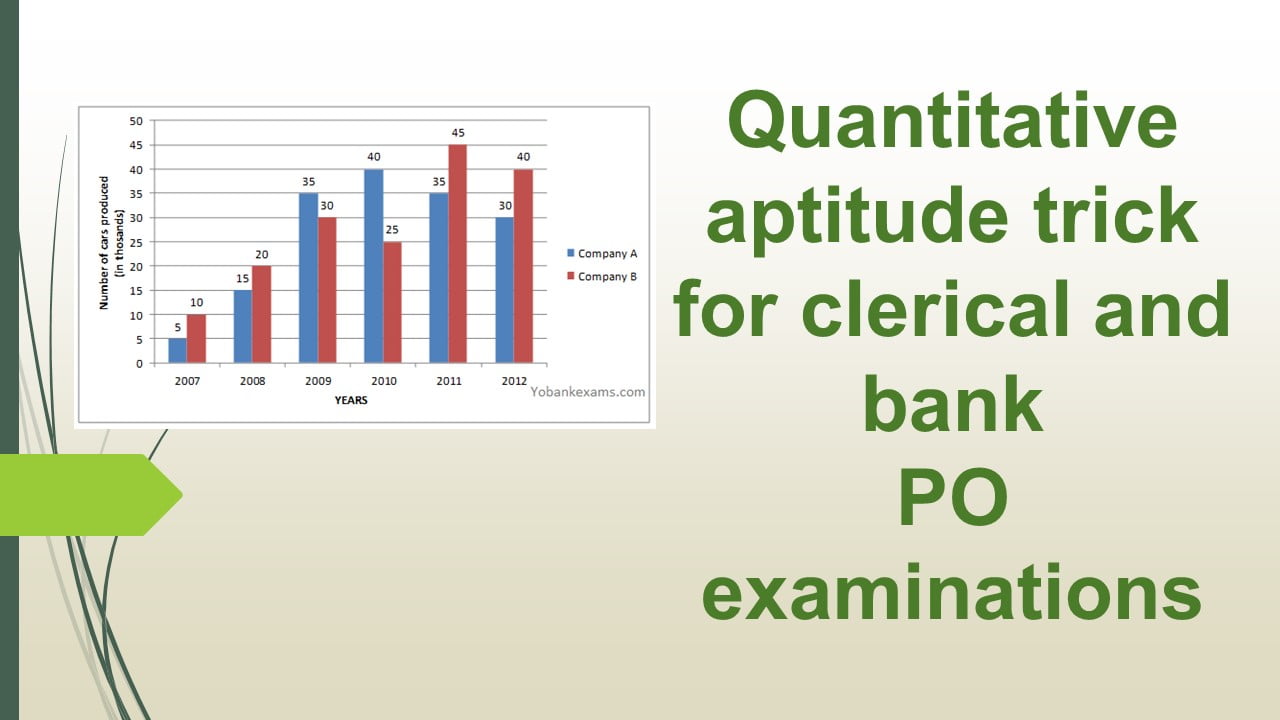
Quantitative aptitude comprises of Data Interpretation problems in bank exams. This is a section which a candidate must aim to score the maximum.
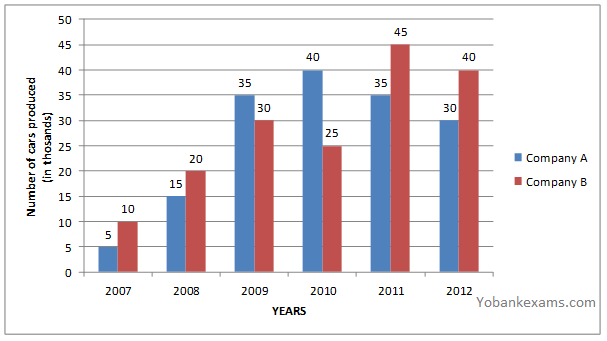
You can use specific data interpretation tricks to solve the problems and aim to ace in the quantitative aptitude section. Below is a typical question asked in the bank exam. We shall see how we can arrive at the answer in seconds using the quantitative aptitude trick.
 
(6)What was the average number of A type cars sold by the company in 2008,2010 and 2012 together?


Steps to find average number of cars sold

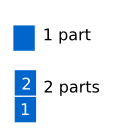
Step 1:Count the number of parts in 2008,2010 and 2012
Step 2:Add the number of parts of 2008,2010 and 2012
Step 3:Multiply the result obtained in step 2 by the scale
Step 4:Divide the result obtained in step 3 by the number of years
Step 5:Multiply the result obtained in step 4 by original units of expression(in this example it is 1 production in thousands)
 

Finding the number of parts in 2008,2010 and 2012
Number of parts of A type cars in 2008=3
Number of parts of A type cars in 2010=8
Number of parts of A type cars in 2012=6

Adding all the parts of A type cars in 2008,2010 and 2012
We get,
3+8+6=17

Multiplying the result by the scale(5) 
we get,17 x 5=85

Dividing the result by number of years(3)
we get,85/3=28.333333

Multiplying the result by 1000
we get,28333

Ans Average =28,333 approximately

This is an approximate answer so we can select an option closest to this number.

Shortcut to subtract any 5 or 6 digit number in seconds

Shortcut to subtract any 5 or 6 digit number in seconds
Shortcut to subtract any 5 or 6 digit number is a trick you can use to subtract 2 numbers in seconds.
Subtraction is the opposite of addition. Suppose we have to subtract two numbers such as 15-2=13.Then,In this subtraction the first number 15 is called the minuend meaning to be made less and the number 2 is the subtrahend meaning that which is to be subtracted and the number 13 is the difference.
Minuend-subtrahend=difference
When Minuend is larger than the subtrahend, there is no problem in subtracting.
Example:Minuend is 162 and the subtrahend is 51 and we are required to subtract the numbers.
1  6  2
–   5  1
———
1 4  1
———
We can easily get the difference whether we do it from right or left.

But what if we had to subtract 45 from 64
if we start using the method of borrowing that we are so used to from our school days no doubt we will arrive at the difference but it is not that easy.

There is a simple trick that you can use here to get the
difference easily and within seconds.


Shortcut to subtract any 5 or 6 digit steps

Lets discuss the steps now
Step 1: Subtract the numbers of the subtrahend from the Minuend 

Step 2: If any digit in subtrahend is more than Minuend then add a circle on difference you get on subtracting.
Step 3:Now wherever circle is there it means the complement of the number(10- number)
Step 4:If there is any digit before the circled number then 1 must be subtracted from the number.

We shall now consider some examples to understand better


Examples on shortcut to subtract 5 or 6 digit number 


Example 1: 47-28=?
Observe that the Minuend is 47 and Subtrahend is 28 where the unit’s place digit is more than the minuend’s units digit.
First we subtract as usual  
  4  7
– 2  8
  ———
   2 1  
  ———-      

Note that 8 is more than 7 so we add a circle on 1
We find Complement of the difference(1)=10-1=9
Subtract 1 from previous number(2) as the next digit is circled
We get 
  4 7       

 -2 8
 ———
 2  1

 1  9    


Ans  47-28=19


Example 2: 37-29=?
Minuend is 37 and Subtrahend is 29
First we subtract as usual  
        3 3
       -2 9
    ———
        1 6    

Note that the unit’s place digit(9) of subtrahend is more than the unit’s place digit(3) of minuend so we add a circle on the difference 

We find Complement of the difference(6)=10-6=4
Subtract 1 from previous number(1) as the next digit is circled
We get, 

 3 3

-2 9

 ———
 1 6
 0 4    


Ans 37-29=4


Example 3: 65381-42497=?
First we subtract as usual  

 6 5 3 8 1
-4 2 4 9 7
 —————
 2 3 1 1 6

Add circle on the digits 6,1,1 as these digits of the subtrahend are more than their corresponding digits in minuend
We get,

  6  5  3   8    1

 -4  2  4   9    7
  ———————
   2  3  1  1  6
  ———————

Now we find complements of the circled numbers 
Complement of 6=10-6=4
Complement of 1=10-1=9

We get, 
  6  5  3  8   1
– 4  2  4  9   7
 ——————-
  2  3 9  9  4
 ——————-
Subtracting 1 from the numbers previous to the circled numbers
We get,
 6  5  3  8  1
-4  2  4  9  7
 ——————
 2  2  8  8  4
 ——————-

Ans   65381-42497=22884


Also see
What is complement of a number?

2 digit multiplication trick whose tens digit is same

2 digit multiplication trick whose tens digit is same
You must be wondering we have learnt so many multiplication tricks for 2 digit numbers,so how is this going to be helpful.Well, Knowing new tricks and where the trick can be applied to get the answer quickly can make all the difference. 2 digit multiplication trick whose tens digit is same is one of those tricks that you will learn today.

Condition to apply this trick is 
When the ten’s place digit is same and the unit’s place digits add up to 10 then you can apply a shortcut trick to easily multiply any 2 digit numbers.

2 digit multiplication trick whose tens digit is same

Now,let us see the steps in detail

Step 1:To get the unit’s place digit multiply the unit’s place digit of the both the numbers.

Step 2:To get the ten’s place digit multiply the ten’s place digit with its consecutive(next) number.

Step 3:Place the result obtained in step 2 to the left of the result obtained in step 1.

Let us now practice some examples

Example 1: 26 x 24=?
We observe that ten’s place digit of both numbers=2
and by adding unit’s place digit of both numbers(6+4=10)we get 10.

Hence, we can apply this trick

Step 1:Multiplying the unit’s place digits we get
Unit’s place digit=6 x 4=24

Step 2:Multiplying ten’s place digit by its consecutive number we get
Ten’s place digit=2 x 3=6

Step 3:Placing the result of step 2 to the left of the result obtained in step 1 we get
624

Ans  26 x 24=624


Example 2: 43 x 47=?
We observe that ten’s place digit of both numbers=4
and by adding unit’s place digit of both numbers(3+7=10)we get 10

Step 1:Multiplying the unit’s place digits we get
Unit’s place digit=3 x 7=21

Step 2: Multiplying ten’s place digit by its consecutive number we get
Ten’s place digit=4 x 5=20

Step 3:Placing the result of step 2 to the left of the result obtained in step 1 we get
2021

Ans  43 x 47=2021


Example 3: 38 x 32=?
We observe that ten’s place digit of both numbers=3
and by adding unit’s place digit of both numbers(8+2=10)we get 10

Step 1:Multiplying the unit’s place digits we get
Unit’s place digit=8 x 2=16

Step 2: Multiplying ten’s place digit by its consecutive number we get
Ten’s place digit=3 x 4=12

Step 3:Placing the result of step 2 to the left of the result obtained in step 1 we get
1216

Ans  38 x 32=1216


Example 4: 65 x 65=?
We observe that ten’s place digit of both numbers=6
and by adding unit’s place digit of both numbers(5+5=10)we get 10

Step 1:Multiplying the unit’s place digits we get
Unit’s place digit=5 x 5=25

Step 2: Multiplying ten’s place digit by its consecutive number we get
Ten’s place digit=6 x 7=42

Step 3:Placing the result of step 2 to the left of the result obtained in step 1 we get
4225

Ans  65 x 65=4225


Example 5: 71 x 79=?
We observe that ten’s place digit of both numbers=7
and by adding unit’s place digit of both numbers(1+9=10)we get 10

Step 1:Multiplying the unit’s place digits we get
Unit’s place digit=1 x 9=09

Step 2: Multiplying ten’s place digit by its consecutive number we get
Ten’s place digit=7 x 8=56

Step 3:Placing the result of step 2 to the left of the result obtained in step 1 we get
5609

Ans  71 x 79=5609