Vedic math trick to check multiplication

Vedic math trick to check multiplication

Vedic maths is the ancient mathmematics discovered from the vedas by Sri Bharati Krsna Tirthaji. My Salutations to the Swamiji for providing us with such a useful and magical tool to solve complex mathematical problems. Vedic math trick to check multiplication is one such amazing trick. This Vedic math trick is an easy method to check if the multiplication of any two given numbers is done correctly.

Vedic math trick to check multiplication steps

Let us now see the how it is done in the steps below.

Step 1:Find the sum of the digits of the numbers to be multiplied separately.

Step 2:Find the sum of the digits of the answer you got on multiplying each of the numbers.

Step 3:Multiply the results obtained in step 1 and find its sum of digits.

Step 4:Compare the sum of digits obtained in step 2 with the sum of the digits obtained in step 3.
If both are same then it means you have multiplied correctly.


Examples
Let us consider an example to understand better

Example 1: 105 x 140=14700

We want to check whether 14700 is the correct answer.
Here is how we can check it
Step 1:Finding sum of the digits of 105
         105=1+0+5=6
         Finding sum of digits of 140
         140=1+4+0=5
Step 2:Finding sum of digits of the answer 14700
          14700=1+4+7+0+0=12=1+2=3

Step 3:Multiplying the results obtained in step 1 we get,
          6 x 5=30
        finding sum of digits of 30
        30=3+0=3

Step 4:Comparing result obtained in step 2 with result obtained in step 3 we notice that
Sum of digits in the both the cases is 3.

Hence, we can conclude that our multiplication is right and we arrived at the correct answer.


Full form of abbreviations related to banking and economics

Full form of abbreviations related to banking and economics

Below is the Full form of Abbreviations that are frequently used in Banking.

SL NO ABBREVIATIONS FULL FORM OF ABBREVIATIONS
1 GDP Gross Domestic Product
2 G-20 Group of twenty
3 IMF International Monetary Fund
4 FII Foreign Institutional Investors
5 MICR Magnetic Ink Character Recognitio
6 MSE Micro and Small Enterprises
7 NDTL Net demand and time liabilities
8 NBFC Non-Banking Financial companies
9 NEFT National Electronic Funds Transfer
10 LAF Liquidity Adjustment Facility
11 SEBI Securities and Exchange Board of India
12 SME Small and Medium Enterprises
13 WPI Wholesale Price Index
14 RRB Regional Rural Banks
15 RTGS Real Time Gross Settlement
16 BPLR Benchmark Prime Lending Rate
17 CBS Core Banking Solution
18 CD Certificate of Deposit
19 CPI Consumer Price Index
20 CP Commercial Paper
21 CRR Cash Reserve Ratio
22 EME Emerging Market Economies
23 IBA Indian Banks’Association
24 NABARD National Bank for Agriculture and Rural Development
25 SLR Statutory Liquidity Ratio
26 NPA Non-Performing Assets
27 CCEA Cabinet committee on economic affairs
28 Economics Excellent Conception of Normal or Maniacal Incidents Conditioning Society


Check how well you know these abbreviations. Take up the quiz now


Shortcut to divide 2 digit number by 5

Shortcut to divide any 2 digit number by 5

Shortcut to divide 2 digit by 5 is an amazing trick you can use to get answer in seconds. Speed with accuracy makes the difference between success and failure in competitive exams.

Shortcut to divide 2 digit by 5 steps

Let us see the steps on how to divide any number by 5

Step 1: Double the given number.

Step 2: Shift the decimal point to the left by one place.

Now we shall practice some examples using this trick

Examples

Example 1: 42/5=?
Step 1:By doubling 42 we get 84.

Step 2:By shifting the decimal point to the left by one place we get 8.4

Ans  42/5=8.4


Example 2:18/5=?
Step 1: By doubling 18 we get 36.

Step 2: By shifting the decimal point to the left by one place we get 3.6

Ans  18/5=3.6


Example 3:24/5=?
Step 1: By doubling 24 we get 48.

Step 2: By shifting the decimal point to the left by one place we get 4.8

Ans  24/5=4.8


Example 4: 73/5=?
Step 1: By doubling 73 we get 146.

Step 2: By shifting the decimal point to the left by one place we get 14.6

Ans  73/5=14.6


Example 5: 37/5=?
Step 1: By doubling 37 we get 74.

Step 2: By shifting the decimal point to the left by one place we get 7.4

Ans  37/5=7.4

Shortcut to find percentage of a number within seconds

Shortcut to find percentage of a number within seconds

Shortcut to find percentage of a number is one of the coolest trick which makes maths fun. With this trick you can mentally find the percentage of any number within seconds. 

Let us understand a simple concept on percentages here

100% of a number will be the number itself
ex:100% of 360 will be 360

50% of a number will be half of the number
ex:50% of 360 will be 360/2=180

25% of a number will be quarter of the number or half of 50% of the number
ex:25% of 360 will be 360/4 or 180/2=90

10% of a number can be found by shifting the decimal point by 1 place to the left.
ex:10% of 360 will be 36.0

5% of the number is half of 10% of a number
ex:5% of 360 will be 36/2=18

15% of the number will be the sum of 10% and 5% of a number
ex:15% of 360 will be (10% of 360)36+(5% of 360)18=54

1% of a number can be found by moving the decimal point by 2 places to the left.
ex:1% of 360 will be 3.60


Now that we know the concept let us see how we can apply this trick in the below examples

Examples to apply shortcut to find percentage of a number

Example 1: 11% of 550 is?
Step 1: Split the number into 2 numbers that we can easily find the percentage of. 
We can split 11% into 10% and 1%

Step 2: First we find 10% of 550 by shifting the decimal point to the left by 1 place.
We get,
10% of 550=55.0

Step 3: Now we need to find 1% of 550 by shifting the decimal point to the left by 2 places.
We get,
1% of 550=5.50

Step 4:Adding both the results
we get 10%+1%=55.0+5.50=60.50

Ans  11% of 550=60.50


Example 2:21% of 250 is?

Step 1: 21% can be split into 10%+10%+1%

Step 2: First we find 10% of 250 by shifting the decimal point to the left by one place
we get,
10% of 250=25.0

Step 3: Another 10% of 250 we get
10% of 250=25.0

Step 4:Now we need to find 1% of 250 by shifting the decimal point to the left by 2 places.
We get,
1% of 250=2.50

Step 5:Adding all the results we get,
10%+10%+1%=25+25+2.50=52.50

Ans  21% of 250=52.50


Example 3: 61% of 754 is?
Step 1:61% can be split into 50%+10%+1%

Step 2: First we find 50% of 754 which is half of the number
we get, 50% of 250=377

Step 3: First we find 10% of 754 by shifting the decimal point to the left by one place
we get, 10% of 754=75.4

Step 4:Now we need to find 1% of 754 by shifting the decimal point to the left by 2 places.
We get, 1% of 754=7.54

Step 5:Adding all the results we get,
  50%+10%+1%= 377+75.4+7.54=459.94

Ans   61% of 754=459.94


Example 4: 98% of 850 is?
Step 1: 98% can be split into 100% – 2%

Step 2: We know that 100% of 850 which is 850.

Step 3: Now we find 1% of 850 by shifting the decimal point to the left by 2 places
we get, 1% of 850= 8.5

Step 4:Now we find 2% of a number,

1% of 850 + 1% of 850=8.5 + 8.5

we get, 2% of 850= 17

Step 5:a Subtracting the results we get,
  100%- 2%= 850-17=833

Ans   98% of 850=833


Example 5: 95% of 620 is?

Step 1: 95% can be split into 100% – 5%

Step 2: We know that 100% of 620 which is 620.

Step 3: Now we find 10% of 620 by shifting the decimal point to the left by 1 place
we get, 10% of 620= 62

Step 4:Now we find 5% of 620 which is half of 10%

62/2= 31

we get, 5% of 62= 31

Step 5:a Subtracting the results we get,
  100%- 5%= 620-31=589

Ans   95% of 620=589

How to check if a number is a perfect square?

How to check if a number is a perfect square?

A number is a perfect square if given number is equal to the square of some natural number.

Using the prime factorization method we can find out if a given number is a perfect square or not. Moreover, by this method you can accurately say whether a number is a perfect square or not. We will not guess the answer as we all know that there is penalty for every wrong answer.
Prime numbers between 1 to 100 are 2, 3, 5, 7, 11, 13, 17, 19, 23, 29, 31, 37, 41, 43, 47, 53, 59, 61, 67, 71, 73, 79, 83, 89, and 97.
Let us now go through the steps
Step 1: Find prime factors of the given number
Step 2 : Group the factors in pairs
Step 3: After grouping if you find that
          → The number is a perfect square if No factor is left
          → Number is not perfect square if Factor/Factors are left
We shall now apply this trick in our example

Examples on How to check if a number is a perfect square

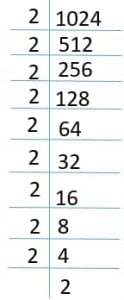
Example 1:Is 1024 a perfect square?
Step 1: Finding prime factors of 1024

verify whether 1024 is a perfect square or not

Step 2: Grouping factors in pairs as shown below 1024=(2×2)x(2×2)x(2×2)x(2×2)x(2×2)

Step 3:After grouping we notice that no factor is left
Therefore, we can conclude that without doubt 1024 is a perfect square.


Example 2: Is 784 a perfect square?
Step 1: Finding prime factors of 784
Is 784 a perfect square?
Step 2: Grouping factors in pairs as shown below784=(2×2)x(2×2)x(7×7)
Step3: After grouping we notice that no factor is left
Therefore, we can conclude that 784 is absolutely a perfect square.

Example 3: Is 3721 a perfect square?
Step 1: Finding prime factors of 3721.
Is 3721 a perfect square?
Step 2: Grouping factors in pairs as shown below
3721=(61×61)
Step 3: After grouping we notice that no factor is left
Therefore, we can conclude that 3721 is absolutely a perfect square.

Example 4:Is 6889 a perfect square?
Step 1: Finding prime factors of 6889.
Is 6889 a perfect square?
Step2: Grouping factors in pairs as shown below
6889=(83 x 83)
Step 3:After grouping we notice that no factor is left
Therefore, we can conclude that 6889 is absolutely a perfect square.
Tip: Remember the squares of prime numbers as it can save a lot of time.